Please read the rules carefully. If there are any questions or something you need to clarify with us we are open and will make decisions so everyone has an equal opportunity for all Believe Derbies.
*No aftermarket or fabricated rear ends of any kind. All rear ends must be five lug no conversions. Aftermarket axles may be used but must be a factory replacement. No axle savers allowed or welded on bracing to strengthen the axle housing or tubes. Rearends must be factory for the car no swapping of rearends must be factory for year make and model.
*All fasteners protruding through the exterior parts of the body must be cut down 3” max above nuts.
Aftermarket Parts allowed- Metal gas tanks, stock style transmission coolers, brake and gas pedal combos, and shifters. These items are meant to improve cars not to be used to reinforce any part of the car.1. The car entry gate will open from 12 pm to 3 pm on the day of the derby.
2. Car inspections will start at 12 pm and close at 4 pm. Final inspections will be done at 4:30 pm if you fail to be inspected again you will not run, build cars according to the rules.
3. There will be a pre-race drivers meeting day of the derby held at 5 o’clock. All drivers must attend or you will not run, No Exceptions.
4. Each driver will have an assigned scoring person; you will have 30 seconds to make a deliberate hit to another car. If your car stalls or breaks down you will have one minute and 30 seconds to get running and make another hit. Drivers will be disqualified for sandbagging, no questions asked. The derby will stop and an official will break your flag.
5. There will be no alcohol consumed in the pit area. This includes drivers and crew. If found drinking the car you are with and the crew will all be asked to leave the pits. The car and driver will not derby No Exceptions. The driver is responsible for his crew.
6. All drivers and crew will need to be paid for and need to have signed the release of liability. Anybody without a band will be asked to leave, No Exceptions.
7. W9 forms need to be filled out and completed by the day of competition or no payout will be received. All checks must be cashed 45 days to receiving the check. All rewritten checks will be 25$ less.
1. Full-face helmets, long-sleeve jackets, and pants must be worn for all drivers.
2. Safety belts must be worn whenever the car is moving. Over-the-shoulder or harnesses are recommended. This will be checked before entering the arena if deemed unsafe the car will not run.
3. It is required that each team have a full fire extinguisher near their pit to avoid any accidental mishaps or fires.
4. The inside of the door is recommended to have a cushion securely mounted to protect the driver.
5. Do not hit the driver's door. If you're on the gas in the driver's door you will be disqualified. We will not have someone get hurt because of this happening.
6. Warnings will be placed on driver’s stick for late hits and door hits. Second warning you will be disqualified. You can be disqualified on the first offense if the hit was done intentionally head official has the final decision.
7. Drivers and pit crew must be over the age of 18 years old.
8. Be careful in the pit area, especially while making repairs; one mistake could end your day. Most events will be filmed so officials will make sure the pit area is safe and easily accessible.
9. If you think you're going to hit someone in a dangerous way, don’t take the shot. If the hit was made and known to be unsafe a tech official will stop the derby and your stick will be broken.
10. Stay aware of the track officials, flags, and other methods of stopping the derby.
1. Any METRIC CAR will be permitted. NOTE: If you break any of these rules and we feel you’re being deceptive to create an advantage while doing it, you won’t participate. You won’t get any options to fix it. This is a beginner class if you want to build and push rules build a limited weld car. This class is designed for new drivers, youth drivers, and/or someone wanting to derby for entertainment purposes only. If you have any questions, please contact us.
2. All, Youth driver doors must be painted orange.
3. Remove the following, before entering the facility: windows, plastic bumper covers, headlights, taillights, all chrome, and mirrors. Interior must be swept clean of debris and glass.
4. DISABLE THE AIRBAG SYSTEM!
5. When using chain, it can only be a max of 3/8 diameter. If using wire, then only 3 strands of #9 from TSC, ACE, or similar are permitted. Washers may not be used to reinforce a hole you run wire or chain through.
6. Front all thread is allowed must be mounted within 1” of core support and can be no larger than 1” thread size, using no more than 3 nuts and washers, one under the frame, either the body puck or a nut equivalent on top of the frame, and one on the hood.
7. Under the hood, you may take plastic fender wells out, strip plastic, and any other unneeded parts. The battery must be mounted inside the car securely and safely but cannot reinforce the car. You may need to lengthen the cables to reach it.
8. Engine swaps are allowed they must be stock. Simple headers are allowed. We will allow the change from EFI to a carburetor. Any car can update the carburetor and distributor but must have an OEM intake manifold.
9. The engine must be mounted with the stock mounts in the stock position. No welding of engine mounts. Factory transmission cross members only and the cross member must be bolted in, not welded. If the car has a wiring harness in front of the core support, you may move it behind the core support. Stand-alone or lengthened harnesses are permitted. The firewall may be cut out or pounded back behind the distributor.
10. Simple cable shifters are allowed. Or you may use 1 solid piece of 3/8 threaded rod directly to the linkage. Must use the OEM gas pedal and brake pedal, as well. However, the ignition may be bypassed.
11. No stock fuel tanks are permitted inside of the car. If using a fuel cell or boat tank, then the cell or tank needs to be securely fastened to the floor with bolts. Your mount cannot re-enforce the car. Ratchet straps or wire are not approved to mount fuel cells. Injected cars may use an internal or external high PSI pump. The 85 F150 pump style is ok.
12. ALL body bolts, mounts, and washers must be factory stock. No altering permitted. If they are broken or rusted off, then you may add 3 loops of wire in the immediate area to secure the body just as the bolt did.
13. Doors can only be chained or wired with one chain or 3 strands of wire per hole. Do not chain/wire more than 8 places per door. The wire at the bottom of the doors may go around the frame. Driver’s door may be reinforced, but if reinforcement is on the outside or inside, do not overlap the door seam by more than 3 inches. Door skins are allowed can not extend 6” past the front and rear door seams. We will allow Door skins on passenger doors if running the two man extreme.
14. Trunks and hoods can only be chained or wired with no more than 8 total places in each. You may use chain, or 3 strands of wire per place. 2 of these places are permitted to go around the bumper and/or frame. TRUNKS AND HOODS MUST BE OPEN DURING INSPECTION! Please create two 10-inch holes in the hood for fire detection. Deck lids and/or tailgates must be in factory position on the car. You cannot smash down or remove the speaker deck from the car. You may cut the rear of the trunk lid off if you choose to. Do not tuck, wedge, pre-bend, notch, fold, or anything else you can think of to modify the trunk, hood, panels, or fenders. No welding washers to the body when using wire or chain. Note: You do not have to run a trunk lid or hood but you must have something covering the mechanical fan if you run one. The rear frame behind the humps may be dimpled or notched and at no time can this be re-welded. ***If you choose to weld the hood you may use 4 locations max with a 2” x 2” 1⁄4” by 5” long angle bolted together with a max of 2 bolts per mounting point max. Mounts may be welded to the car safely but nothing more and can only touch the hood and fender.
15. Air filled tires only**. Must start with a stock wheel. An 8” or smaller wheel center may be added, along with a valve stem protector. No other welding is permitted on the wheels.
16. DO NOT CREASE THE BODY OR FRAME. DO NOT FOLD THE TRUNK LID. IF YOU CREASE THE BODY OR HAMMER THE BODY OR FRAME, BE PREPARED TO CHOP THE WHOLE AREA OUT.
17. You may have a 4-bar cage. A 62” door bar is the max length, and that includes the dash and seat bar. You may install a rollover bar that runs perpendicular to the door bars and can bolt or wire to the roof in 2 places. Cage bars cannot be any larger than 6”.
18. You may have 4 vertical down bars. Down bars must be vertical, not cover any body mounts and cannot be no further forward than the front door seam. If any rule isn’t followed, plan to cut them out. Vertical down bars may be welded to the top of the floorboard only may use up to a 5” x 5” by 1⁄4” flat pad to weld to mounted only to the floorboard
19. 2 pieces of chain or wire can be used in the front window for your protection.
20. Steering and suspension parts can only be the parts that came on the car or the parts must be replaced with box store replacements. No purpose-built parts can be used in place of OEM parts. Twist-in coil spring boosters can be used to help achieve bumper height.
21. Bumper swaps are permitted by only using 1980 & newer bumpers or a straight piece of open-ended square tube measuring 4” x 4” x 1⁄4” with a max length of 65”. Cars that came with bumper shocks must use the shocks for that car. Shocks may bolt/weld to the shock plate and may bolt/weld to the bumper. You may collapse the shock and weld it all the way around to limit it from sliding in and out of itself. You may weld the shock to the front plane of the frame. If your car did not come with bumper shocks, then you may weld the bumper directly to the front of the frame. No squaring or shortening. Instead, use filler in the gaps, if necessary. In either case, you may weld 2 pieces of 2”x 6” steel straps on each side -- from the frame to the bumper, to ensure the bumper stays on. Do not use homemade, loaded, or seam welded bumpers unless using the above-mentioned square tube. Max bumper height will be 18” to the bottom
22. Frame repair (4) 4” x 6” 1⁄4” max. Must be placed on frame only and must be 1” apart
1. Engine swaps will be allowed. The rear of the motor block (not the heads) must start in front of the vertical section of the firewall. Inspectors want to see a gap between the rear of the motor block and the vertical section of the firewall.
2. If an engine swap is done it must be done safely especially when using newer motor configurations with high fuel pressure. Please call ahead so we can make sure The Believe Team feels it was done safely. We want everyone to be safe.
3. If you are using an engine saddle type cradle (see picture below), you may use
aftermarket pads OR two pieces of 2” x 2” x 6” square tubing as lower motor mounts.
a. Your motor mounts can only be welded to the engine cross member.
b. If no pads are used, then the cradle may only be welded with 12” of weld or
bolted to the factory engine cradle, NOT the frame.
4. You may chain the motor down if desired.
5. Sliders will be allowed. If tunnel is cut to accommodate the slider it must be covered.
6. Five lug axles only may be aftermarket but must be stock replacement, no postal style rear ends, braced or conversion rear ends will be allowed.
7. No axle savers or rear end bracing of any kind. Rear ends may have extra brackets for other cars but must not reinforce the axle.
8. Spools or welding of the spider gears will be allowed.
9. Aluminum aftermarket bellhousings are allowed on transmissions.
10. All mechanical fans must be covered and contained. If one gets broken or comes off we don’t want them in the stands.
11. If running a Cadillac you can not weld the fangs to the cross member or go across fangs to re-enforce your car.
1. You are allowed to run pinion brakes or stock brakes. The front or rear must have brakes. You must be able to stop at any time. If you don’t have brakes when you start the derby, you won’t be allowed to run.
2. Air filled tires only.
3. No full wheel centers.
4. No v-cut style tires.
5. Flappers will be allowed on the front and rear.
6. You can run inner tubes, but they cannot be filled with any liquid or foam products.
7. No split or duals.
8. 8” wheel centers max will be allowed.
9. 2” rim guard is allowed.
10. All wheel weights must be removed.
11. Valve stem protectors will be allowed.
12. All tires being used for spares must be inspected by the tech officials.
1. Absolutely NO cutting, welding, pinning, tilting, shaping, bending, adding to or altering the frame/unibody in any other way than specified
2. Steering components must be stock and remain in stock location. No aftermarket hydraulic steering
3. Reinforcement of the tie rods with 3⁄4 x 3⁄4 x 1/8 angle can be used on one side of the tie rod.
4. Suspension will remain stock
5. No coil shocks, air shocks, or shock extensions.
6. All spring mounts must remain in their original positions on the axles and shackles.
7. You may weld, bolt, or chain the a-arms down. Two 3” x 3” x 1⁄4” flat strap can be used to weld a-arms down one on the front and one on the back only.
8. No leaf spring conversions allowed period. If its leaf sprung, it will remain leaf sprung. If coil sprung, it will remain coil sprung.
9. With the exception of 1998-2002 crown vics can run a watts conversation
10. You may also run the leaf spring/coil conversion kit on the rear end do not over weld the rear end or reenforce anything other than just welding the parts supplied to the rear end
11. No loaded or reinforced trailing arms. Must remain stock and untouched.
12. Pin tie rods and ball joints only. Must be OEM tapered style. No heims or bolts allowed. Must have stock a-arm mounting.
13. Frames/unibody may be notched or dimpled between the 2 rear frame mounts. Do not manipulate the frame anywhere else than where specified.
14. K-Frame cars may use one wrap of chain to hold the K-frame to the main frame. Approximately 2’ long.
15. Coil springs may be welded to the axle.
16. Chaining humps is optional. You may only use 1 chain per frame rail. The chain cannot be welded to the frame.
17. The chains can go through the body but chains or washers cannot be welded to the body.
1. The hood may be welded or bolted. If bolted no more than 4 points per fender.
a. bolting with single through bolt- bolts 8” x 1” with max 5” washers per bolt
washers may be only welded to the inner fenders and to the hood. These cannot
be welded across the hood fender seam
b. bolting with angle up to 2-5” individual lengths of angle iron 2” x 2” x 1⁄4” may be
welded to the body back to back and bolted together with one or two bolts, these
cannot be welded across the hood fender seam.**
2. The hood must have a min. of 16” hole cut in it for safety and inspection.
3. 3” x 1⁄4” flat strap or 3/8” rod or redi rod may be used to weld exterior seams
4. No more than two window bars per window.
a. Must be a minimum of 16” from the window pillar.
b. Trunk windows can only be a max of 4” past window seal, or placed on speaker
deck.
c. Window bars may be attached to the halo bar and to the front dash bar only. 2”
x 2” by 1⁄4” square max
5. No changing, welding, doubling, or removing of the rear package tray
6. The driver's door may have a plate covering the exterior footprint of the driver’s door only. The plate cannot extend 6” past the front and rear door seams.
7. If using cutting edges or exterior door straps the ends of the cutting edges must be tapered or a plate welded to the end of them to help stop them from going inside another car.
8. The bar length rules 4 door model cars bar must not extend more than 4” in front of the driver’s door onto the front fender and must not cross the gap at the back of the rear door; on 2 door models, the bar must not extend 4” in front of the driver’s door onto the front fender and no more than 12” past the gap at the rear of the door bumpers.
9. No re-welding of any factory seams is allowed other than what is specified in these rules. If there is any welding on the frame that is not specified in the rules there will be a 3” on 3” off with full daylight slices/cuts in the illegal welded section of the frame.
10. Body may be creased, but no collapsing, or wedging of the rear quarter panels. We will allow a 6” well/dip from the top of the quarter panel to the trunk lid. No wedging of the trunk is allowed. No welding or bolting of created seams.
1. Bumpers must remain stock in mounting and configuration. Passenger car bumpers may
be swapped with any other passenger car bumper.
a. Bumper height must measure to the bottom of the bumper and be a minimum of
15” and a max of 22”.
a. If using factory brackets, they may be welded to the car.
b. If using a collapsible bumper, you may weld at the shock tube but not reinforce it.
2. If you choose not to run a replica or a homemade bumper you may run a max of 6” x 6” 3⁄8” max wall thickness bumper 65” width max.
3. The intention of this rule is to allow you to mount the bumpers in such a way that they are
less likely to fall off. Upon inspection if it is determined that you have exceeded the intention
of the rule you will be given the opportunity to correct it in order to compete, if you are not
willing to correct it you will be disqualified. Officials have the final say.
a. Any Factory passenger OEM, Homemade car shaped (must resemble factory
OEM bumper), or 6” x 6”x 3⁄8” max square tube bumpers may be used, all
bumpers may be loaded.
b. If you use a square tube and add a point to the front of the square tube. The point
must be to the following specs.
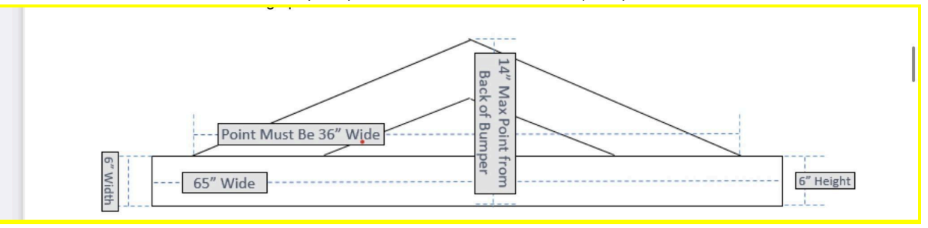
4. If using a nonfactory bumper, you can weld factory mounts directly to the bumper or the bumper to the frame horns.
5. If running front bumper brackets they must be factory to year make and model only or you will be allowed to use a 4” x 14” x 1⁄4” flat strap, one per side, to mount the bumper. You may add a max 3” x 3” mounting method that can only be from frame rail (or bumper bracket) to bumper cannot touch core support or all thread.
6. You may have 2 front and rear bumper straps that can be a max length of 36” x 3” x 1⁄4” and limited to 8” of weld per end.
7. Factory or aftermarket body mount must be in place. There must be a minimum 1⁄2” space between the frame and body. If using aftermarket body mounts, they must be 1” tall and factory diameter. Absolutely, no body mounts may be relocated, added, or welded in place.
8. You may remove all body mount bolts and replace them with 1/2” bolts with 3” washers on either side. Bolts must be up inside of the frame. Nut and washer may be on top of the interior floor sheet metal. Core support body mounts and blots may be removed for all thread.
9. 1” max diameter may be run through the core support mounts and hood. All thread may not be run further back than the core support 5” washers max.
10. Front and rear tire openings may not be cut more than 6” from the tire all the way around.
11. Reattachment of the inner fender is optional.
12. If the trunk becomes smashed upward obstructing your view, you must cut a hole to see behind you before the next heat starts.
13. Fresh cars only will be allowed 4 plates and painted with a bright color prior to tech cars will be allowed EIGHT TOTAL 4” x 6” x 1⁄4” thick plates max size only. Plate footprint cannot exceed more than the 6” x 4” length and width. It is not square inches. Plates not meeting this will be required to remove them completely and may not put them back on.
14. REARBUMPERS may only use a OEM non pointed bumper or a max 6” x 6” 3⁄8” flat tube with a max of 4” x 10” x 1⁄4” flat strap only
1. The steering wheel and columns must be in stock location. You can run aftermarket columns from the steering box back. *Recommended to tape or run closed center steering wheels
2. The shifter can be moved to a desired location. Cable shifters are allowed.
3. If the driver’s seat is replaced it must be bolted through the floorboard with 3/8 or larger bolts with 2” washers on the bottom of the floorboard.
4. A working lap belt or shoulder belt must be securely mounted in the car. A 4 point harness is recommended.
5. Two batteries may be used and must be in a safely designed battery box for containment. The battery box must have two straps to contain the battery. It must be 1” from terminals and anchored to the car with a min of two bolts 3/8 or larger bolts with 2” washers down below.
6. Fuel tanks may not exceed 7.5 gallons and must be relocated to the cage bar or rear floorboard behind the driver safely. Tech to deem safe.
7. Fuel tanks must be metal; no plastic tanks allowed
8. Boat tanks allowed.
9. Fuel lines must be metal with no more than 2 feet of rubber line used for connections, may also use braided line or similar product if deemed safe by tech. All connections must be double hose clamped.
10. Any fuel leaks found may disqualify the car.
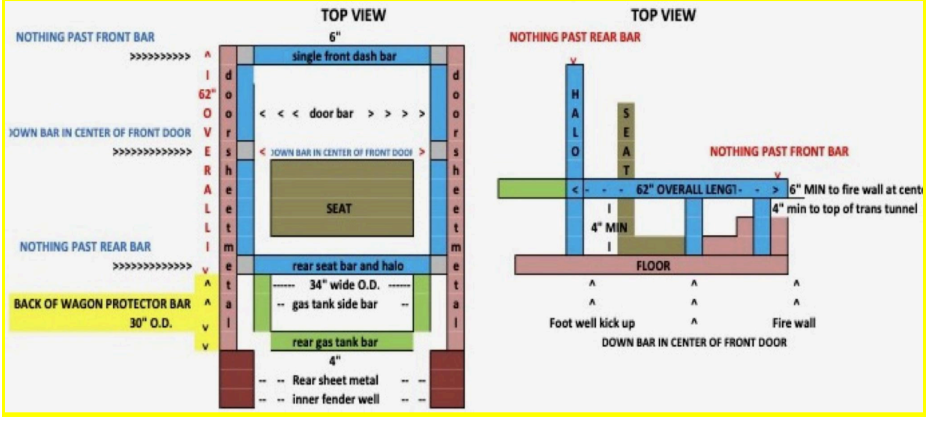
1. Cages must be within the inside of the car.
2. Overall cage length must not exceed 62” including side door bars, rear seat bar, dash bar, and halo.
3. Gussets will be allowed one per corner.
4. You must have a 4” gap between the cage and floorboard with the exception of the 6 vertical down bars.
5. You may have 6 vertical down bars. Down bars must be vertical and not cover any, body mounts. If either rule isn’t followed, plan to cut them out. Vertical down bars may be welded to the top of the chassis or floorboard only.
6. 2” x 2” max tube size bars can be mounted within the 62” of the cage.
7. You must have a vertical rollover bar or halo. It must extend to the roof and have a plate welded to the top of your vertical rollover bar.
8. Halos must be connected to the roof in 3 spots minimum. It can be welded or bolted, It is recommended to use 1⁄2 in bolts and tabs welded to halo for your protection no more than 3 inches wide.
9. Gas tank protectors can be run.
a. Must be centered between your frame humps.
b. It cannot exceed 30” OD in width and cannot exceed the top of the gas tank by
more than 4”.
c. It must be 4” away from all sheet metal and rear window bars. Sheet metal
cannot be removed to achieve the 4”.
d. You may use one 12” horizontal gusset, per side, that goes from the seat bar to
the protector.
e. If driving a station wagon, the protector must be 30” OD of the seat bar.
1. The radiator must be in stock location no exceptions.
2. All hose connections are recommended to be double hose clamped.
3. Electric cooling fans allowed.
4. Must choose one method for mounting radiator
A. 1/4” radiator protectors will be allowed but must not be welded or put in the car to
reinforce it.
B. remounting the condenser in front of the radiator
C. 1⁄4” max thickness metal radiator protector plate no bigger than the radiator mounted
must be in front of the radiator and behind the bumper only allowed 6 mounting points,
bolts 3⁄8” max, welded 3” max or wired
5. Cooling fans must be covered safely tech official decision.